Seminary Program

This is where we post the essays from many of our Universal Life Church Seminary students. When students finish a ULC course, they write a comprehensive essay about their experiences with the course, what they learned, didn't learn, were inspired by, etc. Here are their essays.

Search This Blog

Monday, September 18, 2006

Comparative Religion

Comparative Religion

First, let me say how much I appreciated Rev. Kythera Ann's excellent efforts to put this course together and how much I enjoyed studying with her. This Comparative Religions course was one of the most comprehensive I've ever seen and it was organized in a most logical and exemplary manner. I would definitely take other courses form the Rev. Kythera Ann.


As to how these discourses could be improved, I wouldn't know but I think if something is this good it might as well be left as it is.


What I liked about this Comparative Religion course was the organization of the material, the many excellent illustrations and pictures provided, the clear explanations given on the history, religious anthropology, customs, rituals of the various and several religions both major and minor. I also liked the suggestions for further reading and study and the many excellent and comprehensive references provided at the end of each session.


What I gain form this course:


First, of course I gained important information on the variety of religious experiences within the human family. But more importantly I gained a tremendous insight into the nature of human "soul", or, if you prefer, human nature. To explain this insight let me first quote the statement made by the Venerable Walpola Rahula, who, on the occasion of the World Buddhist Council meeting in Sri Lanka in 1966 made the following statement:


• The Buddha is our only Master

• We take refuge in the Buddha, the Dhamma and the Sangha (see Three Jewels)

• We do not believe that this world is created and ruled by a God

• We consider that the purpose of life is to develop compassion for all living beings without discrimination and to work for their good, happiness, and peace; and to develop wisdom leading to the realization of Ultimate Truth

• We accept the Four Noble Truths, namely Dukkha, the Arising of Dukkha, the Cessation of Dukkha, and the Path leading to the Cessation of Dukkha; and the law of cause and effect (Pratitya-samutpada)

• All conditioned things (samskaara) are impermanent (anitya) and dukkha, and that all conditioned and unconditioned things (dharma) are without self (anaatma).

• We accept the Thirty-seven Qualities conducive to Enlightenment (bodhipak sa-dharma) as different aspects of the Path taught by the Buddha leading to Enlightenment.

• There are three ways of attaining bodhi or Enlightenment: namely as a disciple (sraavaka), as a Pratyeka-Buddha and as a Samyak-sam-Buddha (perfectly and Fully Enlightened Buddha). We accept it as the highest, noblest, and most heroic to follow the career of a Bodhisattva and to become a Samyak-sam-Buddha in order to save others.

• We admit that in different countries there are differences regarding Buddhist beliefs and practices. These external forms and expressions should not be confused with the essential teachings of the Buddha.


I checked out the acceptance of the above statement especially with regards to point #3 with several Buddhist monks I personally know (Sri Lankan, Chinese, Japanese, and Vietnamese) and they all agreed with Rahula's assessment of the interpretation of the Buddha's teachings.

Yet, at the same time, aside form the Buddha's followers most other religions indicate that mankind desperately needs and seeks God or at least some form higher Power. Even if belief in God is only a belief, or sometimes an intuitive knowing, feeling or understanding) and even if God's existence can not be proven scientifically, a large portion of mankind (probably up to 90%) believes in something greater then themselves may that something be called God, Higher Power, Supreme Being, The Great Spirit and so on.


In summary, if there wasn't a "God" (or if God didn't exist) we would need to invent one, for it is in human nature to wanting to turn to something higher then ourselves at times of adversity, intense difficulty, danger, disease, calamity and predicament. Mankind (most of us anyway) needs someone higher then himself to pray to and to find solace in.


As for the statement by the the great Buddhist scholar Rahula that "We do not believe that this world is created and ruled by a God" I can only quote my Master's admonition "Man wants to measure the Ocean of Truth with the cup of his mind"

Rev. Peter A. Somogyi


*******************************

The Universal Life Church is a comprehensive online seminary where we have classes in Christianity, Wicca, Paganism, two courses in Metaphysics and much more. I have been a proud member of the ULC for many years and the Seminary since its inception.

The Universal Life Church offers handfasting ceremonies, funeral ceremonies and free minister training.

As a long time member of ULC, Rev. Long created the seminary site to help train our ministers. We also have a huge selection of Universal Life Church  minister supplies. Since being ordained with the Universal Life Church for so many years and it's Seminary since the beginning, I've watch the huge change and growth that has continued to happen.


Try our new free toolbar at: ULC Toolbar

Friday, September 15, 2006

Shamanistism

ShamanismDr of Shamanic Theology Degree Course Essay
Doctor of Shamanism Final Essay

By Rev. Scott Randall Bobbitt

I have mixed feelings about the course, The Shamanic Method, as it is written. It is obvious to me that a lot of study and work went into it, but it is also obvious to me that it written from a perspective of study and not from a perspective of knowing. It is stated over and over in the text that most of what is written about is difficult or impossible to have first-hand knowledge of, and that is simply not true. One does not have to be a certified “shaman” to intelligently work with and use many of the principles that are outlined in the course. The Shamanic Method is by in large an outline presentation of a great deal of research on the subject of shamanism. This research is well documented and an extensive bibliography is presented at the end of the last discourse. Almost all of the research listed is itself presented from an observational point of view. These observations may have been have made by scholars, but the associated conclusions they reach indicate little or no real understanding of what was observed, and the information presented is basically sterile.

There is almost no first-hand experience or information presented. It is stated many times that only shamans can know the true nature of the realm of the shaman, but only information collected by non-shamans is presented. If there were no books or information available written by shamans or apprentices, then such an oversight would be understandable. Again, this is not the case. I will present a list of references that give first-hand information in this paper. Some of the references are quite well known, standards of the genre even, and I hope that is not the reason they have been omitted from this course. The reason that some of the books I refer to have been popular and well received is because they are well-written and offer first-hand information that can be understood and sometimes used appropriately.

The most disturbing thing to me, and the best evidence concerning the lack of understanding about what has been observed, is the overemphasis on the use of entheogens. While it is true that they are used extensively for various purposes in shamanic work, it is not true that all shamans, apprentices, and shamanic practitioners use them all the time, if at all, or that entheogens are even necessary for all shamanic work. In my own experience and research, hallucinogenic substances are primarily used to introduce the mind of the shamanic apprentice to “non-ordinary reality“, and to help the conscious mind with the acceptance of it. “Non-ordinary reality” is the standard term used to describe the realm of the shaman. Although “other realities” and “different realities” are referenced in the text, I did not see the standard term used, even though it is widely used in all of my shamanic and anthropological references.

One of the most popular series of books on the shamanic experience and the associated apprenticeship was written by Carlos Castaneda.
The primary series of books authored by him are as follows:

The Teachings of Don Juan: A Yaqui Way Of Knowledge (SBN 671-21555-8)
A Separate Reality: Further Conversations With Don Juan (SBN 671-20897-7)
Journey To Ixtlan: The Lessons Of Don Juan (SBN 671-21399-7)
Tales Of Power (ISBN 0-671-80676-9)

Carlos Castaneda was an anthropology student at the University of California in 1960 when he was introduced to Yaqui Indian (Mexican) brujo (sorcerer/shaman) Don Juan. After many conversations and meetings, Don Juan accepted Castaneda as his apprentice. What followed was an extraordinarily detailed account of Yaqui Indian shamanism, which include extremely detailed descriptions of the gathering, preparation, and use of the entheogens peyote, datura, and mushrooms. If one was to read only the first book in the series, it would be reasonable to assume that shamanism is all about the use of hallucinogens, but this would be a mistake. As the apprenticeship progresses over the course of four years, the shaman relies less and less on the use of entheogens until reaching a point where they are not used at all. It is finally revealed and understood that they were used primarily to introduce Castaneda to the many aspects of non-ordinary reality and experience. 

In addition to the first-hand account, the books also include anthropological analysis of the actions and events. The books listed above are required reading for the shamanism part of the Philosophy of Religion Courses offered at the three universities I have attended, and they certainly should not be left out of this course. I appreciate the amount of research that went into the discourses on the various aspects of entheogens and now as a result, I have a great deal more information on the subject than I had before the course. Many thanks!

Other books that give first-hand accounts of shamanic experience that I highly recommend are:

Secrets Of The Talking Jaguar - A Mayan Shaman’s Journey To The Heart Of The Indigenous Soul (ISBN 0-87477-900-6) by Martin Prechtel
Spirit walker - Messages From The Future (ISBN 0-553-37837-6) by Hank Wesselman
Medicinemaker - Mystic Encounters on the Shaman’s Path (ISBN 0-553-10774-7) by Hank Wesselman
The Four Agreements - A Toltec Wisdom Book (ISBN 1-878424-31-9) by Don Miguel Ruiz
Huna - A Beginner’s Guide (ISBN 0-914918-03-6) by Enid Hoffman
The Way Of The Peaceful Warrior (ISBN 0-915811-00-6) by Dan Millman

The second list of books offer a wide range of first-hand experience and information concerning the varieties of shamanic experience. Even though all of them deal extensively with non-ordinary reality, no entheogens are recommended or used by any of the shaman masters or their apprentices. There are other effective methods for becoming attuned to non-ordinary reality and alternative healing methods, and The Shamanic Method does touch on some of them such as meditation, sensory deprivation, sweat lodge, drumming, and hypnotherapy.

Secrets Of The Talking Jaguar by Martin Prechtel is about a Native American from New Mexico’s journey to Guatemala, his acceptance by a group of Mayan Indians as part of their village, and his first-hand experiences as a shaman’s apprentice, and later as a full-fledged shaman over the course of 15 years. The book is very well-written and quite detailed. Native tobacco (nicotine) is occasionally smoked in native made pipes, and it is clear that it is done primarily as a social behavior, partaken of by many of the villagers and not just by the shamans and chiefs.

The books by Dr. Hank Wesselman describe, in great detail, spontaneous, shamanic dreams experienced by the author over a period of several years. Dr. Wesselman has a PhD. in anthropology, and each chapter of shamanic experience is followed by a chapter of anthropological explanation and analysis. The explanation of non-ordinary reality as experienced by shamans of different cultures worldwide is quite fascinating.

The last two discourses in this course concern shamanic behavior and ethics. I think that it is appropriate for this course to touch on these things as they are very important considerations. Again, these take the form of instructions and information with no real insight into the shamanic reasoning behind them. The Four Agreements by Don Miguel Ruiz is a book that addresses exactly that. Don Ruiz is a Toltec Indian (Mexican) shaman master who explains the primary morality of not just Toltec shamans, but for all people, as seen from a Toltec point of view. This is another book with a wide ranging popularity that has become a classic in the field.

Huna - A Beginner’s Guide by Enid Hoffman takes the reader into the world of the Kuhuna or Hawaiian/Polynesian shaman. This is another book that deals extensively with non-ordinary reality and the nature of human consciousness. Huna divides spirit into three parts: a nature spirit or low self called unihipili, a human spirit or middle self called uhane, and Divine spirit or high self called Aumakua. It is clear that Polynesian shamans understood the nature of consciousness long before the advent of modern psychology.

The Way Of The Peaceful Warrior by Dan Millman is not a typical “shaman book.” It does however describe, in first-hand detail, a master/apprentice relationship within the context of non-ordinary reality, that takes place within a contemporary (Berkeley, California) setting. Interestingly, Millman’s follow-up book, Sacred Journey Of The Peaceful Warrior, takes place in Hawaii and involves direct Huna shamanic experience.

I was familiar with these books and others, many years before taking this Doctor of Shamanism course. While I would never call myself a shaman, I have studied, experienced, and employed shamanic methods since the mid-1970s. I am also a long-time student and practitioner of Druid and Wiccan methods, magic and witchcraft, Kabalistic and Gnostic mysticism, Hindu methods, and Zen Buddhist meditation to mention but a few. I would not label myself as any one of these either. I am a certified transpersonal (body, mind, spirit) hypnotherapist, and certified in several alternative healing arts including four disciplines of Reiki, Orthobionomy, and human energy field work (chakra, meridian, and outer body energy clearing and balancing). I guess what I’m saying here is that shamanic practice crosses over into all of these realms of thinking and experience, and all have value within the realm of experience.

Living in Santa Fe, New Mexico gives me an unusually large and varied opportunity to have shamanic experiences and to incorporate them into my daily life. One cannot leave the city in any direction without finding yourself on Native American land (pueblos). Each pueblo has its own holy man/woman or shaman. Santa Fe also has a wide variety of shamanic practitioners from which to choose for a reading or treatment. The very first day I entered town, I consulted a shamanic practitioner who also has an advanced degree in psychology. While she did employ drumming and chanting, and used tools such as rattles and an eagle feather, she did not use entheogens in any way.

I very much appreciate the copious amounts of information presented in this course. It has increased my informational reference on the subject tremendously. Information does not become knowledge however, until it is actually experienced. Collecting lots of information only for the sake of having lots of information makes one a librarian or scribe, and will never give anyone actual knowledge. Reference information becomes useful if and when it is applied to the living of one’s life. Undertaking the direct experience of any or all of these practices should be done only after much study, great deliberation, and with clear intent and heart. None of this should ever be done for the hell of it or for some anticipated thrill! I would also like to repeat that valid shamanic experiences may be obtained without the use of entheogens. My own experiences have proven that to me.

Thank you very much for making such an interesting and relevant course available to us! I am already enjoying the two courses that I have enrolled in since this one.

Be well and blessed be,

Scott


*******************************

The Universal Life Church is a comprehensive online seminary where we have classes in Christianity, Wicca, Paganism, two courses in Metaphysics and much more.

Ordination with the Universal Life Church, is free,  and lasts for life, so use the Free Online Ordination, button.We also offer many free wedding ceremonies for your use.

The  ULC, run by Rev. Long, has created a chaplaincy program to help train our ministers. We also have a huge catalog of Universal Life Church materials.  I've been ordained with the Universal Life Church for many years and it's Seminary since the beginning and have loved watching the continual growth of the seminary.


Try our new free toolbar at: ULC Toolbar

Wednesday, September 13, 2006

A Course In Miracles

Dr. of MetaphysicsWhat is Metaphysics?

Prior to this course I would have thought it was some type of science. I would have been right to a degree but to bring that understanding to a sharper idea I would describe it as the Science of One. It is the great secret held from man. It is the law of attraction, connection and quantum physics all in one. Prior to the course, I was a student of all beliefs, traditions, and religions. With an open mind I have gone threw most of the major belief systems. There are many common threads in the ideas but the missing link is metaphysics.

Metaphysics sets all the responsibility right on your lap. Right where it belongs. The release of guilt and understanding of positive thought and action coupled with the lessons learned allows one to excel beyond the guilt. It becomes like a trampoline in that at first it is hard to begin but once momentum is achieved there is unlimited drive. Not to say one will not fall from time to time but once you have got the momentum once thane you know how to get it back. Once you understand the principals you have no real limit to what you can achieve.

Recently the global view is beginning to shift. As we are all connected on the energy level as thoughts shift more people learn these truth’s the easier it is for the whole to accept. You can see the curiosity in others when they hear the word consciousness. There have been documentary films put to the mainstream. “What the Bleep Do We Know?” and “The Secret” have made the facts quite clear. This is very positive because once you hear something you can’t forget it. The more people begin to see the benefits other achieve they will be drawn to question how this is done. How do they live a life where they seem to be in control, where luck is abound? Metaphysics loosens the shackles of the physical world through understanding. The more you shine, the more others will follow and the understanding will free them. It is like a chain reaction that has already begun.

I dream of a world in which we can all see the only truth. Where we understand that we are all equally free. That we all work with one power source. That we shape our whole world on how wither we choose to act or react to situations. Someday perhaps we will come to an understanding that we are all blessed, rich, powerful beings who have a much greater control over the things around them than they could ever believe.


Matthew T. Volk


********************************************

To ordain yourself with the Universal Life Church, for free, for life, right now, click on the Free Online Ordination link.

Rev. Long created the ULC seminary site to help ministers learn and grow their ministries. The Seminary offers a huge catalog of materials for ministers of the Universal Life Church, as well as an online seminary program and a chaplaincy program.


Try our new free toolbar at: ULC Toolbar

Spirit Quest

Universal Life Church Seminary offers online Seminary Courses.
Final Essay on: Spirit Quest

Spirit-Quest Essay

Written by Reverend Jeanette Buschman

I have found Spirit-Quest to be very thought provoking and helpful in realizing the power of the mind, body and spirit.

At the beginning of the Spirit Quest discourses I was asked to write down my spiritual goals and when I’d like them to be realized, and then I was asked to write down on a separate piece of paper some short term goals. For short term, I had written down 14 goals, as of today, 7 of the 14 have been realized; 50% isn’t bad. As for my spiritual goals long-term with a time line, I haven’t reached the end of the allotted amount of time I have given myself to bring these goals into manifestation. The dates range from 3-2006 to 10-2006. The ones realized have been to strengthen my relationships with my immediate family members, thanks be to God, my relationships have elevated to a healthier level. It has been a never ending struggle with my teenage son. He has a good heart and is very spiritual, but also still very young, 15 going on 30, or so he thinks.

I have to remind myself of how it was when I was 15 yrs. old.

The one for manifestation by 5-2006 was to be financially stable. Again thanks be to God, this goal has been also realized.

I believe in setting goals, you strive to manifest them, thus achieving them.

I would agree with the lesson about being true to yourself and others makes you a person of your word, which with your word comes intention. Your intention drives the force of your being.
In regards to forgiveness, I believe that forgiveness is essential to a sound mind, spirit and body.
To carry that heavy burden around is a barrier that hinders your spiritual growth and progress. To forgive is divine -- it brings you a step closer to God. A person needs to realize that any feelings you have are yours by choice, you choose to feel a certain way.

No one can make you feel a certain way nor can they change you any more than you can change them. It is all a personal choice. A personal choice to forgive, to love, to get bitter or to get better. I choose better.

In regards to the meditation process and all of the tools I have learned about there of, I have found this to be very helpful, relaxing and a thought-provoking experience. I had never envisioned being inside of my own mind, the 3rd eye, to view what ever my mind desires. Your Star-trek analogies are great.

The grounding cord created by me was an awesome connected feeling.

In a past hypnosis session I had experienced using a grounding cord to stay grounded.
This gives me a feeling of being connected to the elements of the earth more than I had ever experienced before.


After releasing and dropping foreign energy, I experienced the golden suns as an inspirational God given illuminated love that filled my being guided by the Holy Spirit. This is an awesome feeling. Spiritual indeed.

Postulating a foreign energy-absorbing protection rose has been beneficial in protection from others energy. Also using a rose for creating and destroying energy, or any thing that you do not want in you is a wonderful symbolic release of that thing that has become a hindrance.

Until this discourse I had not delved into the practice of the different types of energies, cosmic, earth and the seven charkas. This was very interesting and I believe with a lot of practice can be beneficial for the energy flow of the body.

The process of spiritual mock ups to manifest your desires, are along the same line in my opinion as prayer and a positive thought process. As most of us know, we should pray the desired result, provision not the problem. Jesus prayed this way.

People can have what they say, but instead they are saying what they have.
Confirmation is the key here.

I agree that competition can be a very unhealthy spiritual experience, it can tempt a person to accept the feelings of inadequacy, not being good enough to be best, when actually we are all equal in the eyes of the Lord. Total acceptance and a feeling of peace and love are far more important than being first or right. We need to remember that we are all part of the whole, all equal, all children of God. Equal brothers and sisters in Christ.

I have read a book called many lives, many masters that is about reincarnation. The book is about people’s past life regressions to deal with present life issues that have been of question for one reason or another. I have a very open mind in regards to this subject. The Bible does state that we were preplanned, known by God even before birth.

I have come to total acceptance that every thing in life happens for a purpose, even if we don’t understand or like it. There is usually a lesson to be learned.

This is total acceptance of God’s will.

In the grand scheme of all things, we can either accept God’s will or in a sense, we can continue to tread water. This of course gets you no where fast.

In regards to karma I have to agree that the movie called Pay it forward is a must see.
If all the people in the world would follow the lesson that movie teaches, what a wonderful life we all could lead. We can not change nor control the things of the past, but the present
(a gift from God) and the future are ours to create.

The W.W.J.D. (What Would Jesus Do) motto is a wonderful one to use every second of your life. It is hard to do any harm or damage if you think this way.

I really love the concept of coping with every day life by being amused by it.
Amusement being referred to as a vibration in relation to a color is imaginable by my thought process to defuse a situation, lesson and to alleviate the stress factor.

When there is fear and tenseness of a thought that is undesirable, by simply thinking of the color pink in a splatter pattern with yellow stripes in the back ground with dark pink hearts floating through out the picture in my minds eye made me feel much better immediately.

Wow, what a concept. This was some what similar to finding your happy place in a tense situation and going there, but more uplifting. I had not thought about how the spirit communicates in three different ways, color, music and numbers.

I can relate to the music part first hand. I have been given words to a few songs; one of these songs came to me while in the shower. My husband plays the guitar for praise and worship at our church, so I gave him the words that the Lord had given to me and he was instantly given music that seemed to be meant for this song. PRAISE JESUS !!!

This has happened a few times now. These songs are spiritual songs we sing at our non-denomination church.

We have experienced this with another friend of ours that is also part of the band at the church. God is sooo good !!!!!

These words are given to me when I least expect it, on my motorcycle, in my pick up truck, in the shower and even during prayer. We have a sister in Christ at our church that has been blessed with an awesome art talent, her paintings are very much spirit guided. She is guided to paint certain pictures that have a message or meaning, and a name is given to her for the painting.
As far as music and vibrations are concerned, I agree that we all have a certain rhythm to our bodies and spirit, these rhythms are either soothing or irritating.

Kinesiology is a true and tried method to address just about any thing in your life that is in question. My son had been labeled A.D.H.D. very early on in his childhood, we went to see a holistic Doctor who used this method to pin point possible allergies to foods and elements he was exposed to. This method truly works.

I have no doubt that telepathic means of communication is definitely when you are speaking in spirit. This happens with my husband and I all the time. We have been married for 23 years now and more times than not can finish each other’s sentences, this is at times annoying but really neat at the same time. There are times when I will be thinking of some one and want to talk to them and they’ll call me. At times I know who is calling when the phone rings. I found it useful to use a sticky collection rose to clean and clear out my telepathic channels.

I have played with spiritual hellos, telepathic thought sending and suggestive thought sending. The response was variable and interesting, this was dependant on the person involved. Even my dog (Bruno) seemed to pick up on my thoughts. I was very surprised at the awareness of my thought sending that people exhibited. The people that I am closest to seemed to pick up on it stronger than others.

The different levels of astral travel were very interesting to learn about. I remember once when I was lying in bed, all of a sudden I was looking down on myself, this startled me so much at that moment, I did not understand it at the time, but unfortunately I have not been able to do it again. I have read about how people travel to all kinds of places, and can tell you what was going on at that place. Wow !!

I can only imagine what it will be like when I meet my maker ( God ) and realize all that we are truly capable of.

In lesson # 27, the past, present and future-based types of people are discussed, I would say that I am a present type or person with a healthy perspective thought process of the future.

I found it very interesting to learn about spiritual pain and how it can have an affect on our health. I look forward to reading Louise Hay’s book (You can heal yourself ).

I believe that past life experienced pictures formed in the mind and how those experiences are perceived in your memory can affect your present and future well being. That which you resist becomes more persistent.

To own something, admit it, claim it and deal with it so you can go on with out it being empowered by you giving it undo energy and strength.

As far as money is concerned, I have to admit that it is and has been a have it when you need it type of situation, if I have extra it is put to use to where it is needed for personal reasons or other’s needs. I have become comfortable with the fact that the Lord does provide me and mine with what is necessary in life. Sure you can always use more money, but in the end it is all spent, rather you have a lot or a little amount.

We have done the big financial in debt up to our ears, make the minimum payment until you die dance more times than I care to admit. We have gotten to the point to where we are on a cash and carry basis or lay away. If we want it, we have to save for it or pay on it without interest.
If we had all the interest we have paid over the years on credit, wow, it would really add up to be a lot of money.
Of course this does not include big items like a mortgage payment or vehicle payments.
I have been blessed with the things that are needed in life.

My husband works very hard to provide for our needs and the amount always seems to be enough. We are a somewhat traditional family, I am still a stay at home Mom that keeps house and am in the process of home schooling a 15 year old son and have a 21 year old daughter that is doing well for herself, and of course I am working on acquiring the knowledge and credits to get my Dr. of Ministry degree through Universal Life Seminary program.

I have pursued other interests in life such as a licensed nail technician, truck driver, school bus driver, sales, foster care and the list goes on. This however is not just an interest, this is a calling. A call for a higher purpose in life.


I do have to state that the Spirit-Quest course has been very thought-provoking and that it has taught me about a mental visual way of thinking that is helpful for an over all sense of well being. I would recommend this course to any one seeking more insight into self awareness.

Thank you for sharing this insight with me.

God Bless,
According to God’s will,
In complete servitude,

With love,
Your sister in Christ,
Reverend
Jeanette Buschman


*******************************

The Universal Life Church is a comprehensive online seminary where we have classes in Christianity, Wicca, Paganism, two courses in Metaphysics and much more.

Ordination with the Universal Life Church, is free,  and lasts for life, so use the Free Online Ordination, button.

The  ULC, run by Rev. Long, has created a chaplaincy program to help train our ministers. We also have a huge catalog of Universal Life Church materials.  I've been ordained with the Universal Life Church for many years and it's Seminary since the beginning and have loved watching the continual growth of the seminary.


Try our new free toolbar at: ULC Toolbar

Monday, September 11, 2006

Unvarnished Gospels

Four Gospels Study Course
I found the modern translation of the Gospels to make for easier reading but it lost the majesty and beauty of the King James version.

But now on to the main portion of my essay.

Since the Gospels tell the news of Jesus, I thought I would concentrate on His teachings and try to contrast what Jesus taught and some of what modern Christians believe.

Jesus' really only told his followers to do 4 things His teachings break down to
1. Love God and keep His law
2. Love your neighbor better than you love yourself
3. Keep sexually pure
4. Remember Jesus' death

To expand on these 4 points just a bit, based on the Gospels.
1. Love God and keep His Laws.
One thing that Jesus taught was that He did not come to this earth to make new laws, but to fulfill the law. Jesus never taught that the law of the Torah was no longer valid, in fact, He spent most of his time teaching that it was not only to be obeyed to the letter, but was to be obeyed in spirit also. The law was to be a part of our every day life, it was to guide your every thought and action. The law that God gave to Moses in the form of the 10 Commandments was not over turned or changed by Jesus. As an aside here, Jesus seemed to teach that God only was to be worshiped. As the Son of God, Jesus discouraged any worship of Himself, even refusing to be called good, when only God could be considered good.

2. Love your neighbor better than you love yourself.
Jesus really tried to get this point through to his students. This principle is a basic part of Judaism, but Jesus extended it to include all people, not just members of your tribe or people that believe your beliefs. Every one we meet in our day to day dealings is our neighbor, and are to be treated as well as we would treat ourselves. Everyone we meet was created by the same God that created us, and should be treated like one of God's creation. One thing that Jesus did teach is that there is evil in the world and that we must not tolerate evil, but to try help change evil to good, and if evil will not change, we must have nothing to do with it.

3. Keep sexually pure.
Jesus had some things to say about sexuality. He told us not to commit adultery and to be faithful to our spouses. At no time did he say we should remain celibate. In fact sexuality is a big part of Jewish tradition. But Jesus did say to remain faithful to the ones we married, even complaining about the ability to divorce that Moses had allowed. Jesus also let us that even to think of adultery was just a step away from committing adultery. Thought is father of the deed.

4. Remember Jesus' death
At the last supper Jesus told his students to keep the memory of His death alive by partaking of the Last Supper every time they got together. It is interesting that this was one of two rules that Jesus added. He said that we should have the ritual bathing (baptism) to be saved, and to remember His death. Not too many new rules were added.

What I find interesting is that many Christians today seem to be worshiping Jesus as God, and not as a messenger of God (even though Jesus was the Son of God). This is in violation of the commandment of not having any other gods before God.

Another thing that I find interesting is that you walk into almost church building today and you will see what could be considered an idol of Jesus hanging over the altar.

So ends my final essay

If you feel that this is sufficient for completion of my course, then could you send the credentials to

Stephen E. Williamson

*******************************
As an ordained minister with the Universal Life Church for many years and it's Seminary since its inception, I've had the privilege of watching the Seminary grow. I've been a member of ULC for many years and our site has created a terrific ULC Forum. We also have the most extensive catalog of Universal Life Church materials.

To ordain yourself with the Universal Life Church, and to become an online minister, for Free, for Life, right now, use the Free Instant Online Ordination, button -- Click the link!

I've been a member of ULC for many years and our site has created a terrific ULC Forum. We also have the most extensive catalog of Universal Life Church materials and seminary courses. As an ordained minister with the Universal Life Church for many years and it's Seminary since the beginning, I've enjoyed watching the continual growth of the seminary.


The ULC Seminary has created an RSS Feed. RSS stands for Real Simple Syndication and through the magic of the internet, we can post articles and news stories and have them appear right on your personal computer screen through Yahoo, MSN, AOL or Google. It's a great way for you to keep in constant touch with what's new at the Seminary. Please use any of these buttons below, so you can personalize your


or Google page to give you a daily, self-updating feed of information from the Seminary. For more information on how to do that, go to the RSS Feed page or click the appropriate button.

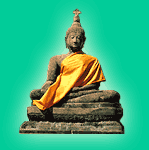
Buddhism Course


The origin, traditional Buddhism began in the 6th century BC with the
historical personage born Siddhartha Gautama, but better known by a variety of titles including Shakyammi, Tathagata, or most commonly Buddha, the enlightened one. The legend of the Buddha’s life has acquired plenty of variations and embellishments over the years, but the basic facts are accepted as traditional, including the dates of his birth and death (563-489 BC by Western reckoning, 624-544 according to Sri Lankan tradition). The story of Buddha’s birth is encrusted with myth and fable as that of any God-figure in human history. For instance, he is said to have issued from his mother’s womb stating that his cycle of rebirths was about to end.

Again, some Buddhists devoutly accept the fables as we in the west accept Christmas narratives, while others choose to focus on the truths beneath the myths.

We do know with some certainty that the Buddha was born to a royal family in northern India, in the foothills of what is now Nepal. Siddhartha Gautama led a sheltered existence in the court of his father, Shuddhodana, the king of the Shakya clan, who shielded him from any knowledge of human suffering or religions of the time. Soon after his birth a soothsayer named Asita predicted that he would become either the emperor of all India or if the "Four Passing Sights" should come to pass he would renounced the world and would become the greatest spiritual leader the world has ever known. Shuddhodana, Gautama, a member of the warrior-ruler caste, preferred the royal vocation and provided his son with three palaces located so that his son would not experience the dramatic seasonal changes. He place at his son disposal anywhere from 10,000 to 40,000 dancing girls to keep his mind firmly rooted in the "real" world. He also gave orders that his son should never see the sick, the aged, dead bodies, and nor should a monk be allowed near his son. But, as so often happens when manipulative fathers groom their
sons to take over the family business, Siddhartha rebelled. At 16 he married a beautiful young princess named Yasodhara, by whom he fathered a son, Rahula. Over the ensuing years Gautama, was shielded from the facts of the real world. But legend states the gods intervened with what is now called the "Four Passing Sights." In essence, the many variants of this story run
something like this. Gautama is either riding or being driven along the roads of his fathered lands when on successive days he first catches site of an ancient man frail with age, representing the miserable close of every man’s life. The next day he encounters a man covered with repulsive sores and shaking with illness, so he may know how physical illness and misery may attend man all the days of his life. On the third day he sees the body of a dead man, which teaches him the dreadful fact of death and his limited time in this world. These three sights robbed him of all peace of mind. (It is a fact, and perhaps the legend is based upon it, that in one of the oldest passages in the Buddhist writings he is reported as saying: "I also am
subject to decay and am not free from the power of old age, sickness and death. Is it right that I should feel horror, repulsion and disgust when I see another in such plight? And when I reflected thus to my disciples, all the joy of life which there is in life died within me.")

The prince remained distraught throughout the remainder of that day pondering these revelations. On the fourth day he beheld a calm ascetic walking toward him as he traveled the road, from this person, who had gained true peace of soul, he learned how freedom from the miseries of old age, disease, and death may be won. His father sensing his son’s troubled thoughts over the past few days decided to hold a great feast in Gautama honor, something to sway his son back to the path chosen for him at birth, but Gautama surveying the scene of debauchery was revolted by its apparent meaninglessness. After the feast when he was awake, alone, and sober he decided it was time to renounce his present life and to seek his own way in the world. So later that night, he bid his wife and son goodbye and set out on a six year quest, searching for an end to life suffering, its true meaning. At the beginning Gautama was anxious not to reject the prevalent Brahmin philosophy until he had tested it for himself. So, for awhile, he traveled India and experimented with the yoga meditation traditions. 

For years he practice the asceticism of the
yogis of the time, nearly staving to death in the process of finding a
permanent release from suffering. Finally he came to the conclusion that
asceticism in and of itself was not the answer. No matter how much he
fasted, he eventually had to replenish his body so that he could continue
traveling and learning. Furthermore, he surmised that the only logical
conclusion of denying the physical body is death. During his last, life
threatening fast, he realized that enlightenment could be reached only
through the vessel of the body, and there was a limit to how much
deprivation his body could safely endure. So he abandoned the extreme
asceticism he had been practicing in favor of what came to be called the
Middle Way a path between devotion to pleasures of the senses and the
complete denial of them. Accepting food and drink offered him; he ate, to
regain his strength. He then went and sat under a nearby Bodhi tree refusing
to move until he became enlightened. In the early morning hours as he sat
under the tree, he realized the nature and cause of suffering and the way of
release from these causes that constituted his enlightenment. He came to
understand that one could be freed from suffering in this life by moderating
its real causes: passionate craving, hatred, and ignorance. According to
legend, after sitting in meditation for seven days, Gautama looked up at the
heavens and said, "How wonderful, How wonderful.

All things are enlightened exactly as they are!" He then continued to meditate for a total of 49 days, for it was at this time all Buddhist down through the ages believed, Gautama, first experienced Nirvana: the goal of Buddhism; it means freedom
from karma; extinction of all craving; the realization of the true nature of
the mind. This is the closest thing in Buddhism to the western world’s idea
of salvation, the ultimate goal of all religious faiths. The word itself is
a Sanskirt word meaning "blown out," like a candle, representing the
extinguishing of all craving. It is believed that during this time he was
tempted by Mara, the evil one, to keep this insight to himself and continue
to realize this bliss, to shed his body and forego a return to the real
world. The Buddha: the Enlightening One, as Gautama later became known,
chose to wander the land begging for food and shelter and teaching the
Middle Way to the men and women of his time. When Buddha preached his first
sermon, following his enlightenment, the sermon is usually titled "Setting
in Motion the Wheel of Dharma," he put forth the Four Noble Truths that he
experienced in the course of his enlightenment. 
1) All existence involves
suffering (duhkha). 
2) The cause of suffering is craving (trishna). 
3)
Release from suffering (nirvana) comes through eradicating passionate
craving for material or sensual satisfaction. 
4) The way to achieve that release is the Eightfold Path. These eight ways of right being encompass mindfulness, and concentration. 

For the next 45 years, Buddha preached this path to all that would listen, and at the age of 80, the Buddha died. He left no writings. All Buddhist scriptures are based on accounts of his life and teaching passed down orally by his disciples from generation to generation. Traditionally, the accounts were committed to writing in Sanskrit and in Pali, a Sanskrit derived Indian dialect within 100 years of the Buddha’s death, but modern scholars places the dates closer to the 2nd
and 1st century BC. The written records of his sermons and dialogues are known as sutras. Unlike other major religions of the world the concept of a divine being, as in, Hinduism’s Atman-Brahman, Judaism’s Yahwey, and Islam’s Allah, Buddhism does not proclaim any worship of any god. Buddhist believes that the divine being, per say, is not something you believe in, or worship, or can describe but instead something you experience. Buddhism’s concepts of
deliverance rest’s solely within the individual experience. Because of this emphasis on experience, the terminology of Buddhism is often elusive. More attention is given to how to attain the experience than a specific description of its character. Indeed Buddhism teaches that no verbal description of the rapture is possible. That is, Buddhism insists that experience is indescribable. This, I believe, can be explained by Buddha’s revelation under the Bodhi tree when he exclaimed, "All things are enlightened exactly as they are!" with no other explanation necessary in his initial experience.

With this we can deduce that Buddha believed that all he has searched for was within him and all things all along. To expand upon this let say that if all things are already enlighten as Buddha exclaimed, then we can assume the search for enlightenment should begin and end within ones self. Taking this further we should be able to see that Buddha believed his deliverance from human suffering rested within his own means and that no divine intervention was essential to achieve true awaking. One other thing, we the western world misperceived the life’s true nature, we think of it as relative. The Buddhist believes that when we truly understand the world then
and only then will we experience nirvana. Also remember, when Buddha chose the Middle Way, he sheded all pre-concepts of the Hinduism teachings in proscribing a path to moksha, the attainment of the Atman-Brahman relationship, and the release from Maya, or the illusion world of the Hindu faith. He theorized that a release from suffering (duhkha) or from the cravings, hatred, and ignorance of ones life were the keys to nirvana, the awaking, the only thing needed to find ones true self or salvation for want of a word. Rituals and Practices Buddhism is not a single monolithic religion.

Many of its adherents have combined the teachings of the Buddha with local religious rituals, beliefs and customs. Little conflict occurs, because Buddhism at its core is a philosophical system to which such additions can be easily grafted. After the Buddha's death, splits occurred. There are now three main systems of thought. First, there is Southern Buddhism or Therevada Buddhism, is mainly found in Burma, Cambodia, Laos, Sri Lanka and Thailand, and parts of Vietnam. Second, Eastern Buddhism or Mahayana Buddhism's is the predominant religion in China, Japan, Korea and much of Vietnam. They celebrate New Years, harvest festivals, and five anniversaries from the lives of Buddha and of the Bodhissattva Kuan-yin. 

They also engage in Dana, Sila, Chanting, Worship and Pilgrimage. Third there is Northern Buddhism which has perhaps 10 million follows in parts of China, Mongolia, Russia and Tibet. The heads of the Gelu School of Buddhist teaching became the Dalai Lama, and ruled Tibet. They developed the practice of searching out a young child at the time of death of an important teacher.  The child is believed to be the successor to the deceased teacher. They celebrate New Years, harvest festivals and anniversaries of five important events in the life of the Buddha.

Common rituals and practices between the three denominations are as follows: Dana - thoughtful, ceremonial giving.

Sila - accepting Buddhist teaching and following it in practice of refraining from killing, stealing, wrong behavior, use of drugs, and on special days, three additional precepts may be added, restricting adornment, entertainment, and comfort. Karma - the balance of accumulated sin and
merit, which will determine ones future in the present life, and the nature of the next life to come. The Cosmos - consists of billions of worlds grouped into clusters; clusters are grouped into galaxies, which are they grouped into super-galaxies. The universe also has many levels: our
underworlds and 21 heavenly realms. Paritta - ritual chanting Worship - of relics of a Buddha, of items made by a Buddha, or of symbolic relics.

Festivals - days of the full moon, and three other days during the lunar cycle are celebrated. There is a New Year's festival, and celebrations tied to the agricultural year. Pilgrimages - particularly to Buddhist sites in Sri Lanka and India.

In Buddhism, I have not found a new religion. I have found a method to help me find the answers that have eluded me my whole life. I still have a long, long way to go. I can say however, that the practice has made me more aware of the nature of mind and, I think, an easier person to live with. May all beings be free of suffering and their minds free of affliction!


Rev. Eric Jennings


*******************************
The Universal Life Church is a comprehensive online seminary where we have classes in Christianity, Wicca, Paganism, two courses in Metaphysics and much more. I have been a proud member of the ULC for many years and the Seminary since its inception.

The Universal Life Church offers handfasting ceremonies, funeral ceremonies and free minister training.

As a long time member of ULC, Rev. Long created the seminary site to help train our ministers. We also have a huge selection of Universal Life Church  minister supplies. Since being ordained with the Universal Life Church for so many years and it's Seminary since the beginning, I've watch the huge change and growth that has continued to happen.


Try our new free toolbar at: ULC Toolbar

Comparative Religion

Rev. William Fowler
Final Essay


This course has altered my beliefs. The term ‘altered' is used purposely because my basic beliefs (a GOD [my term herein for the ultimate singularity], that appears within, Golden Rule, all religions are different paths up the same mountain) are the same. However, my appreciation for the variety, intensity, and validity with which others hold varying beliefs, has truly grown in astronomical proportions.

Rev. Kythera Ann did an excellent job on both layout and content of the course.

The layout – picking a general topic and giving a parity/disparity comparison with different religions – worked very well for me. Combining those comparisons with the exercises (some were wonderful, such as St. Ignatius Spiritual Exercise) and the reading recommendations, gave me some very insightful moments.

A special accolade is offered to the author, on the depth and variety of the reading recommendations. A partial list of books read during this course: Book of Mormon, Bhagwad Gita (English version The Holy Geeta), writings of John Wesley, Gospels of Thomas, Mary, & Judas, The Emerald Tablet, Pistis Sophia (not finished yet), Guru Granth Sahib (also not finished yet), The Manichaean Body, Awakening the Buddha Within, etc. etc. Thank you!

Visiting different faith services was a favorite exercise. I attended Sikh Satsang, Hindu Temple & library (discovered one of the best on the west coast is here in Livermore, CA), Universal Unitarian, Catholic Mass, Ecclesia Catholica Evangelica (Isis based) & EGCH (Gnostic & Hermetic based) Masses, and Methodist Church, so far.

Particular lessons of interest included lessons 3 & 4, which helped strengthen my knowledge in similarities in the various religions. They also gave me a reference to use while reading religious and metaphysical documents. Before taking this course I was not consciously aware that all religions taught “seek within”, now I look and find it, in one form or another, in almost every text.

Lessons 7&10 contained materials I have studied before and still found new nuggets of useful knowledge. Beginning with Theosophy (I too had always associated that term with Madam Blavatsky) then Hermeticism and Alchemy, I reopened prior texts for a slightly new view of their materials.

Lesson 9 reminded me of a Pythagorian theme that GOD used geometry to create the Universe (so I perused an old tome on Pythagorus, noting that among reused symbols is the ‘christian’ fish, a story attributed to Pythagorus [500 years before Christ] and the square root of 3).

Lessons 13 & 14 again reinforced the commonalities, this time in architecture, that I can now recognize in other religion related structures. The picture of the Babylonian Ziggurat is almost identical to Mayan pyramids (as opposed to the Egyptian pyramids).

Lessons 16 & 17 were mostly new ground. Angels were really the only messengers of any previous familiarity, so these two lessons were delightful.

Lessons 18 & 19, on the other hand, impressed me most with the diversity of organizational systems ( and titles), that all seem to work. Successful military and business organizations around the world all fall into a rather finite number of variables in comparison. By this I mean, a Colonel in an American Infantry unit would have a counterpart with similar title and almost exactly the same duties, responsibilities, and organization under and over them, in any of the major militaries in the world. A Catholic Priest and a Buddhist Priest, other than title, would have completely different jobs and support organizations above and under them.

A Conclusion from the course

This course has, in my mind, validated that virtually all the religions studied, in one form or another, see us as all connected within to an ultimate reality other than the ‘perceived physical world’ (TAO and Buddhism by definition, Hinduism [Bhagwad Gita chapt 9-4], Christian [John 10:34-38], the principle of ‘HAL’ in Sufism, etc.). Yet the course also clearly points out how, thru inclusion of exclusion, virtually all the religions define themselves thru physical attributes that many will defend “unto death”.

In the past, when asked, “ which is right?” or “should I/we convert?” or similar questions, I had tried to counsel people on the commonalities of philosophy between the religions. They are basically the same so practice the one that makes you feel good about yourself and want to do good things (good being defined in the heart of the aspirant). Now it appears that, at least some of the time, I can counsel people on the differences between religions and still say the same, “practice the one that makes you feel good about yourself and want to do good things.

******************************************************
Answers to author’s questions
What was gained from this course, as indicated above, was a greatly expanded knowledge and appreciation for the various religions studied.
What was best is difficult to say, too many items compete for that title.
What I liked least and a possible improvement (possible is used because it may have been the course’s design intent) area is the absence of conclusions (like the one above, which you may or may not agree with) that pull the information together is such a way as to answer the questions that will come at us as inter-faith representatives.
This comment aside, my satisfaction level is a 9 of 10, and certainly would be interested in future course by Rev. Kythera Ann.
Sincerely,
Rev. William Fowler


*******************************

The Universal Life Church is a comprehensive online seminary where we have classes in Christianity, Wicca, Paganism, two courses in Metaphysics and much more. I have been a proud member of the ULC for many years and the Seminary since its inception.

The Universal Life Church offers handfasting ceremonies, funeral ceremonies and free minister training.

As a long time member of ULC, Rev. Long created the seminary site to help train our ministers. We also have a huge selection of Universal Life Church  minister supplies. Since being ordained with the Universal Life Church for so many years and it's Seminary since the beginning, I've watch the huge change and growth that has continued to happen.


Try our new free toolbar at: ULC Toolbar